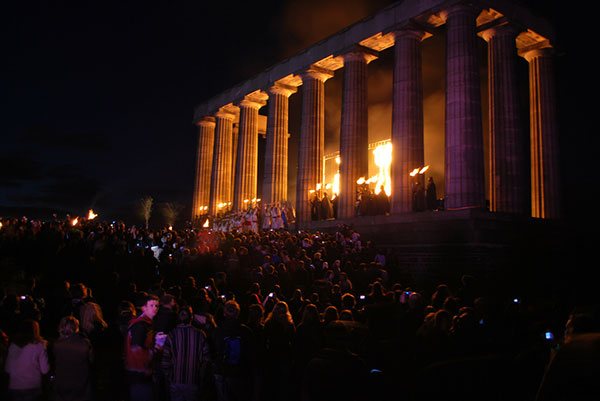
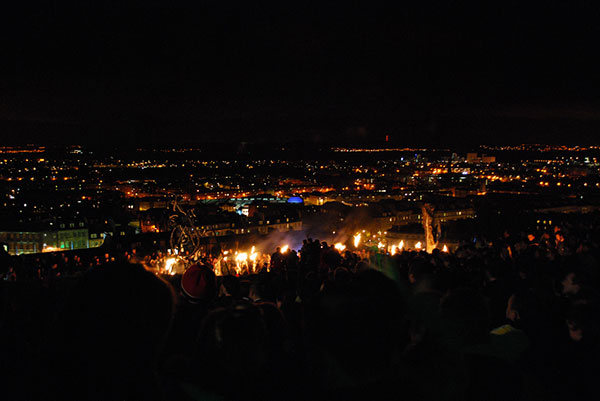
On Beltane night, April 30, thousands of revellers trudge up Calton faerie Hill in the heart of Edinburgh.
They wrap up warm and bring their friends. Some paint their faces or wear flowers or ivy bands in their hair. They leave behind the brightly lit city streets and cosy pubs to scale the hill’s steep slopes in all weathers. The end of April can be unforgiving in Scotland as wind, rain and sleet batter the unwary.
As the sky darkens the hill fills with bodies - all waiting expectedly for the revealing of the May Queen that marks the beginning of the Beltane Fire Festival.
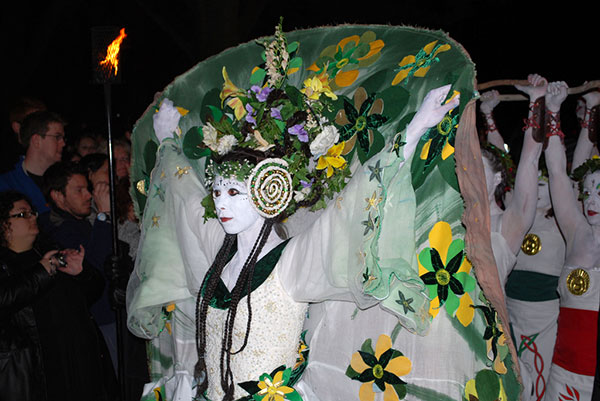
A neidfire is lit. Fire torches burst into flame and a line of drummers and torchbearers form along the high stone steps of Calton Hill’s Acropolis. As the drums thunder to life the May Queen, Green Man, Blue Men and White Women appear in the midst of burning fire sculptures and horn blasts.
Beltane is not a stage show. It is not a music concert or a piece of traditional theatre. It is not a religious ceremony or an ancient ritual. It is somehow all of these things and more.
‘No person neither man not woman [shall] resort or repair hereafter to the Dragon Hole, as they have done in times bye-gone, namely, in the month of May, nor shall pass thro’ the town with the piping and stirling of drums, as heretofore they have done, under the pain of twenty shillings to the poor... also that they shall make their public repentance upon ane Sabbath day in the presence of the people.’
- Kirk-session Register of Perth, May 2, 1580
May celebrations have proved notorious for hundreds of years. Edinburgh’s Beltane Fire Festival was born as a protest against years of repressive government. It grew from a discontent with Thatcher’s treatment of Scotland and flourished in opposition to criminal justice act legislation that sought to prevent groups from gathering. Over the years it has battled funding problems and massive cost increases to survive and become an internationally respected fixture within Edinburgh’s festival calendar.
Beltane appears in Visit Scotland print and TV adverts and in the Scottish Governments official Homecoming Scotland 2009 events calendar. What began as a tiny alternative festival created by industrial musicians and physical theatre performers has become a huge open-air celebration embraced by Government and the Tourism sector.
After the 9/11 attacks in New York the cost of insuring any event including fire skyrocketed. Beltane has always struggled to pay for itself. None of the performers or crew are paid. Everyone works in their own time and with their own money to make costumes, rehearse and choreograph all the elements of the festival. Beltane folk throw themselves into year-long fundraising with clubs, busking and special events. The Beltane Fire Society has to raise thousands of pounds every year to pay for hire fees, insurance and to pay of the cleanup of the hill. It receives no regular funding.
‘All the young men and maids run gadding overnight to the woods.. In the morning they return bringing with them branches of trees... but the chiefest jewel they bring from thence is their Maypole... this stinking idol... covered all over with flowers and greens, bound round about with ribbons... with two or three hundred men and women and children following it with great devotion... then fall they to banquet and feast, to leap and dance about it as the Heathen people did at the dedication of their idols, whereof this is a perfect pattern, or rather the thing itself.’
- Phillip Stubbes, Anatomy of Abuses, 1583
Hundreds of performers, musicians and crew participate every year. They are all ages, from different backgrounds, countries and cultures. Some are religious – from a variety of faiths – some a non-religious. Some put Jedi on their census forms. Edinburgh’s Beltane is a festival with pagan roots but it is not a neo-pagan festival or ceremony. Beltane is a ritual celebration of the coming of summer. It is the last night of the dark winter and the dawn of the light half of the year.
The May Queen is at once the Goddess, the Queen of Elfland and Bride, the Summer Maiden. She is the winter hag, the Cailleach Bheur, reborn as a young girl. She sweeps away the frost and snow and ice and brings the yellow to the broom, the May flowers and the blossom to the trees.
Her consort is the Green Man, the new King of Summer. He begins Beltane night as a tangled overgrown mass of green ivy and oak leaves. At the climax of the festival he is stripped – his foliage torn from him as he dies and is reborn as the new life of spring, the spirit of the woods.
You will find hundreds of Green Men grinning out at you in churches and cathedrals across Europe. They seem to be some curious pagan creatures snuck into the cloisters to taunt the faithful. Vines of foliage burst from their mouths and sometimes their noses, eyes and ears. These foliate heads have been a controversial topic among folklorists and historians for decades.
‘Some things in their natural state have the most vivid colours.’
- Willow, The Wicker Man, 1973
The May Queen appears in village pageants across Britain. Local girls become the pageant queen and dress in white dresses with floral crowns. The May Queen as Goddess appears in the tales of Donald Mackenzie and a painting by the Scottish artist Margaret MacDonald, wife of Charles Renne Mackintosh. Mackintosh painted a companion piece to The May Queen entitled The Wassail. They were originally displayed opposite one-another – the May Queen of Beltane and the Wassail of Halloween. MacDonald’s May Queen is attended by four white ladies. All wear long white dresses and flowers in their black hair – as do Beltane’s White Women.
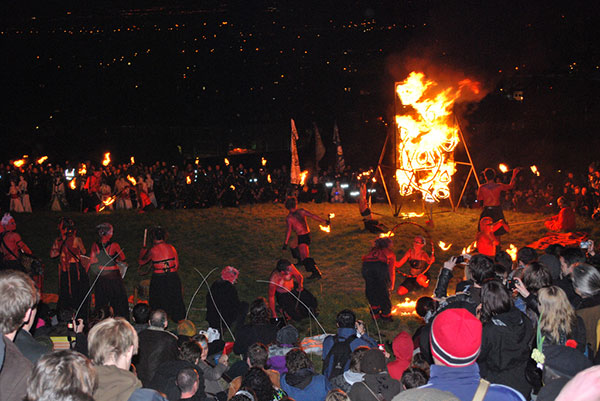
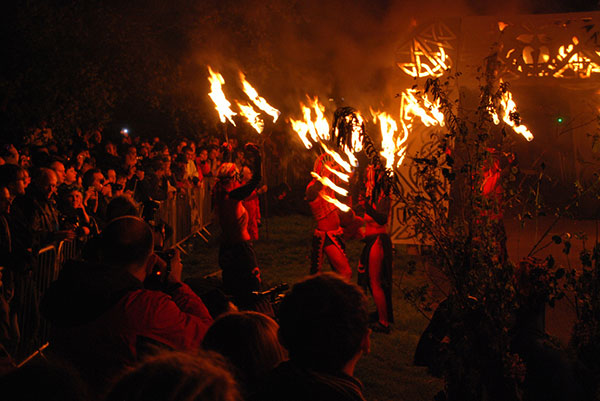
As the procession rounds Calton Hill, the White Women line up to ward off the Red Men. As the White Women are order, discipline, strength and beauty so the Red Men are chaos, mischief and wantonness. Their skin is painted a fiery red. They dance and provoke and play and try to lead the White Women astray. They climb over and through the crowds. They are the Lords of Misrule.
‘The month of May was come, when every lusty heart beginneth to blossom, and to bring forth fruit; for like as herbs and trees bring forth fruit and flourish in May, in likewise every lusty heart that is in any manner a lover, springeth and flourisheth in lusty deeds. For it giveth unto all lovers courage, that lusty month of May.’
- Sir Thomas Malory, Le Morte d'Arthur
Edinburgh’s Beltane Fire Festival is a weird and magical event. It is one night when thousands of people gather to make merry on a cold and windswept hill in Scotland. They drag their friends along and wonder what’s actually going on as hundreds of strangely costumed and painted characters run amok and frolic past them. They warm themselves by the Beltane bonfire and a few make it back up the hill to watch the sun rise on May morning or to wash their faces in the dew.
Visit: www.beltane.org
All Photos by Martin Robertson
|