| 
There has been much debate of late as to the
true age of the pyramids. Perhaps we have all heard about
the discussions and arguments that have erupted in books and
on the internet regarding the era in which the Sphinx at Giza
was constructed. John Anthony West and Robert Schoch have
made a veritable industry out of speculation regarding the
amount of weathering that is present on the Sphinx itself
and its enclosure, and how the era of its construction can
be gauged by this observation. It is an interesting discussion
and one that apparently has much life left in it - I am sure
it will run and run. But erosion of the Sphinx is only one
small aspect of the evidence available when assessing the
age of the pyramids, there are plenty of other examples of
erosion that also point towards an earlier date for the pyramid's
construction. Personally, I think that many of the early dynastic
monuments in Egypt have a tale to tell in the weathering patterns
that scour their fabric, and in the book "Thoth, Architect
of the Universe" I try to explore many of these telltale features.
So let us indulge ourselves in a quick tour
of Lower Egypt and see what evidence is there to support the
concept of a very early construction date for the pyramids.
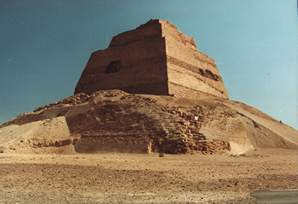 The
first example of pyramid erosion that I want to look at lies
a little south of the Dahshur pyramids - at Meidum. The pyramid
at Meidum is the one that looks as though it has collapsed
and the prime clue to the true age of this pyramid can be
derived from those very upper pyramidal cladding stones that
are now missing from this pyramid - what exactly happened
to them? Various authors have argued that these upper cladding
stones, the remaining lower portions of which are still apparent
under the piles of rubble around the pyramid, have either
been stolen in subsequent eras or they have collapsed in a
kind of pyramidal avalanche. But perhaps this was not actually
the case. From a later excavation of the rubble surrounding
the pyramid in the early 1990s, it was quite apparent that
the pyramid had simply been eroded away by the weather, like
so many of the less well-made pyramids in the area. Unfortunately
for the builders, while the central core of the pyramid was
made of a fairly durable limestone, the attempt
to turn the edifice into a true pyramid used a very weak and
friable stone. This stone has proved about as durable as mud-brick
and although initially quite solid looking, the blocks that
have been exposed to the elements are extremely fragile. The
first example of pyramid erosion that I want to look at lies
a little south of the Dahshur pyramids - at Meidum. The pyramid
at Meidum is the one that looks as though it has collapsed
and the prime clue to the true age of this pyramid can be
derived from those very upper pyramidal cladding stones that
are now missing from this pyramid - what exactly happened
to them? Various authors have argued that these upper cladding
stones, the remaining lower portions of which are still apparent
under the piles of rubble around the pyramid, have either
been stolen in subsequent eras or they have collapsed in a
kind of pyramidal avalanche. But perhaps this was not actually
the case. From a later excavation of the rubble surrounding
the pyramid in the early 1990s, it was quite apparent that
the pyramid had simply been eroded away by the weather, like
so many of the less well-made pyramids in the area. Unfortunately
for the builders, while the central core of the pyramid was
made of a fairly durable limestone, the attempt
to turn the edifice into a true pyramid used a very weak and
friable stone. This stone has proved about as durable as mud-brick
and although initially quite solid looking, the blocks that
have been exposed to the elements are extremely fragile.
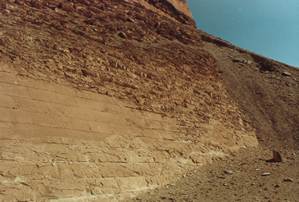 The
fact that the pyramid has eroded and not collapsed, can be
clearly seen in the rubble around the pyramid, which consists
of layer upon layer of small stones. These stones form the
type of strata that are always associated with eroded and
deposited materials. It can also be seen that, where the rubble
has protected the base of the pyramid, the cladding stones
there survive intact. But higher courses, which were exposed
to the elements for a longer period, have been successively
eroded more and more, until at about six meters up there is
complete erosion. The
fact that the pyramid has eroded and not collapsed, can be
clearly seen in the rubble around the pyramid, which consists
of layer upon layer of small stones. These stones form the
type of strata that are always associated with eroded and
deposited materials. It can also be seen that, where the rubble
has protected the base of the pyramid, the cladding stones
there survive intact. But higher courses, which were exposed
to the elements for a longer period, have been successively
eroded more and more, until at about six meters up there is
complete erosion.
Clearly this is due to exposure to the elements
with the stones at the lowest levels, which were first covered
with rubble descending from above, being preserved the most.
Yet one still wonders how long it takes to erode a complete
pyramid, even if the stone was a little friable, for in places
some ten meters of stone have eroded away at Meidum. The current
shape of the pyramid, results from the fact that the upper
flat section at the top of the rubble marks the start of another
step of harder limestone just under the surface; the present
layout is therefore quite stable and may not have changed
for some considerable time. Is is possible, however, that
so much of a solid stone construction was eroded in just under
5,000 years? Personally, I think not, and the supporting evidence
I was looking for became apparent while strolling around the
Giza pyramids.
I was trying to explain some of the technical
details of the pyramids to my wife and it is one of those
facts of life that one never really knows a subject until
it has been successfully explained to a novice. The novice
does not always understand the first time and so the topic
has to be explained again from another perspective. Then,
just when you think that there is no more to say on the subject,
the novice hits you with a question that you were neither
expecting nor can easily explain. The thick limestone paving
slabs upon which the pyramids were constructed comes right
into that category. My wife asked, "Why is there a line
running down this pavement?"
The initial answer to this was easy for, when
fully finished, the casing blocks of each of the pyramids
invariably stopped short of the pavement edge, such that one
particular pavement slab was partly covered by the casing
and also partly exposed to the elements. The exposed portion
of this slab was therefore beginning to erode over the years,
slowly but surely, more and more as the years went by, as
exposure to weather and the feet of millions of pilgrims took
its toll. But the stone masons were normally wise in their
choice of stone and the amount of weathering
is minimal in comparison to what we find at Meidum. As we
can see from the remaining cladding stones that still cover
the Bent Pyramid and the upper portions of the Khafre Pyramid,
in the sub-desert climate, good quality stone usually weathers
quite slowly.
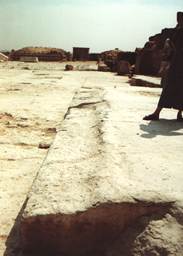
Then, after many millennia, someone came along
and started pilfering the cladding stones from the pyramids,
something that is usually ascribed to the eighth or ninth
century AD. From this time onwards, the whole of the paving
slab was now exposed to the elements and started to weather,
hence a line was formed in the paving stones between the two
periods of weathering. But there was a curious anomaly here
that made me sit and think for a while. When looking at both
the Dahshur and the Giza pyramids, there would appear to be
a large differential between the pavement that has been covered
for a while and the portion that has always been exposed.
This is true within one single slab of stone, this is not
a case of dissimilar stone strengths. Then there was a little
pause in the discussion, for it was obvious now that this
little line in the pavement could now be used to date the
pyramids, but what would it tell us?
With ruler in hand, I tried to estimate the
extent of the erosion, using the base of the remaining facing
blocks as a guide to the original surface of the pavement.
It was not the most precise of experiments, given the tools
at my disposal, but luckily the amount of erosion was easily
visible. At Dahshur the amount of erosion on the covered half
of the slab was approximately five millimetres, the sort of
erosion one might expect in such a climate over 1,000 years
of weathering, yet on the exposed portion of the stone there
was about 50 mm of erosion. At Giza the differential was even
greater. The amount of erosion on the covered portion of the
stone was again about five millimetres, and the exposed had
between 50 mm and a massive 200 mm of erosion.
In general, it would appear that there was a
minimum of ten times as much erosion on the exposed section
of each block as on the portion that had been covered with
the cladding stones, and this would give us a direct indication
of the true age of these pyramids. If a constant erosion rate
is presumed and if the time elapsed since the cladding was
stolen is about 1,000 years, then the time required for the
erosion of the exposed sections of each slab would equate
to about 10,000 years and quite possibly much much longer.
Remember that this is true within a single slab
of stone, it is not a case of dissimilar stone strengths.
Indeed, some of the softer slabs in the pavement have been
eroded more than usual on both the covered and the exposed
sections, and this weathering is in direct proportion on both
sides of the divide. This would seem to indicate that this
erosion process is a valid tool for dating the pyramids, for
each stone tells the same history, no matter how hard or soft
it is. While a 10,000-year history for the pyramids agrees
quite well with John West's Sphinx argument,
it conflicts strongly once more with the traditional history
of the region. Nevertheless, this era is in agreement with
some more interesting and quite persuasive evidence that lies
a little south of Giza - it has been carved into the fabric
of the Dahshur pyramids.
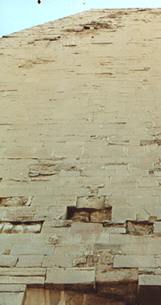 Passing
through the small military area and onto the Dahshur plateau,
the vast bulk of the Red pyramid (Draco pyramid in the book
"Thoth") lies before you. The casing blocks have, of course,
been removed and what is visible are the rough-hewn sandstone
core blocks. The sandstone is relatively friable, but its
high iron-stone content seems to form a tough oxidised ruddy
layer on the surface of the blocks, hence the usual appellation
for this pyramid. Passing
through the small military area and onto the Dahshur plateau,
the vast bulk of the Red pyramid (Draco pyramid in the book
"Thoth") lies before you. The casing blocks have, of course,
been removed and what is visible are the rough-hewn sandstone
core blocks. The sandstone is relatively friable, but its
high iron-stone content seems to form a tough oxidised ruddy
layer on the surface of the blocks, hence the usual appellation
for this pyramid.
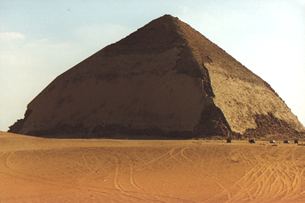
That most of the pyramids are in this parlous
state is a great shame, we would know so much more of the
era and methods for their construction if they were still
in pristine condition. But there is a pyramid that can give
us some clues here, take a look around the corner of the Draco
pyramid and the curious form of the Bent pyramid looms into
view (Vega pyramid in "Thoth", each being named after the
stellar location they represent). Firstly, it is my contention
that the Vega pyramid was not hastily finished off, it was
deliberately made in this fashion with a bent upper portion.
For if you extend the line of the upper outer casing down
to the ground, the shape, size and volume so created is exactly
the same as its northern partner, the Draco pyramid. This
shape is also directly formed from the Pythagorean 20-21-29
triangle, with cubit measurements of 200, 210 and 290 forming
the sides of the pyramid - a sure indication that the designer
knew what he/she was doing.
More importantly, though, the Vega pyramid retains
much of its outer casing, which forms an impressively smooth,
straight surface all the way to the top of the construction.
Approaching the base of the pyramid, the fine workmanship
of the massive casing blocks is easy to see. Other items are
not so obvious - the core of this pyramid, despite being right
next to the Draco pyramid, is made from a different material;
rough limestone instead of sandstone blocks, with a mud mortar
in between form the basic shape. For the casing blocks, however,
the mortar is replaced by a fine pink mastic, apparently so
strong that many of the casing blocks have split into two
before the mortar itself gave way.
But this is not all, the basis of this new evidence
for the age of the pyramids is another curious feature - the
surface of the stones. At some time in the long history of
these pyramids, a long forgotten pharaoh looked at the Vega
pyramid and said to his chief of public works "We must do
something about the condition of this pyramid!" The chief
acted immediately on these orders and started erecting scaffolding
all over the four faces of the pyramid. This
was no mean feat, for wood is not a readily available commodity
in Egypt and convoy after convoy of Lebanese cedar had to
be brought in to provide the working materials. Slowly but
surely a great lattice work of poles covered the entire face
of the pyramid - right to its very apex.
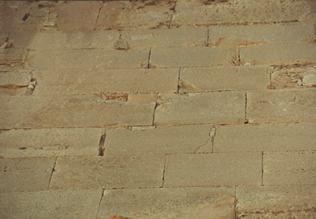 A
team of several thousand artisans, some skilled, some not
quite so, started chipping away at the casing blocks. Stone
is not a uniform material, of course, and small fault-lines,
cracks, and shoals (sand inclusions) within the limestone
blocks each weather at a different rate. Over the years the
Vega pyramid had become pockmarked with thousands of small
patches of erosion in the casing blocks. Some were minuscule,
only a few centimetres across, some required the removal of
the face of an entire stone (not the entire stone as the casing
blocks are some 2m thick, only the outer face was taken away
and replaced). Each and every defect was chipped smooth and
a new piece of limestone was neatly placed in the hole and
smoothed down to a perfect surface. The pyramid then began
to look like it had acne, with the fresh white of the repair
blocks contrasting strongly with the older surface. So the
entire face of the pyramid was scrubbed clean of the sandy
coloured patina that had developed over the years, to display
the brilliant white Tura limestone casing as it was in its
new condition. Pharaoh looked at his achievement with pride
- the pyramids were as new again, sparkling in the ruby glow
of a bloated setting sun. He truly must be one of the greatest
of pharaohs to have achieved such a feat and the gods must
have been pleased. As a record of his great achievement the
pharaoh dared the almost sacrilegious, he carved his cartouche
in the lower casing blocks to the pyramid and within the mortuary
temple. A
team of several thousand artisans, some skilled, some not
quite so, started chipping away at the casing blocks. Stone
is not a uniform material, of course, and small fault-lines,
cracks, and shoals (sand inclusions) within the limestone
blocks each weather at a different rate. Over the years the
Vega pyramid had become pockmarked with thousands of small
patches of erosion in the casing blocks. Some were minuscule,
only a few centimetres across, some required the removal of
the face of an entire stone (not the entire stone as the casing
blocks are some 2m thick, only the outer face was taken away
and replaced). Each and every defect was chipped smooth and
a new piece of limestone was neatly placed in the hole and
smoothed down to a perfect surface. The pyramid then began
to look like it had acne, with the fresh white of the repair
blocks contrasting strongly with the older surface. So the
entire face of the pyramid was scrubbed clean of the sandy
coloured patina that had developed over the years, to display
the brilliant white Tura limestone casing as it was in its
new condition. Pharaoh looked at his achievement with pride
- the pyramids were as new again, sparkling in the ruby glow
of a bloated setting sun. He truly must be one of the greatest
of pharaohs to have achieved such a feat and the gods must
have been pleased. As a record of his great achievement the
pharaoh dared the almost sacrilegious, he carved his cartouche
in the lower casing blocks to the pyramid and within the mortuary
temple.
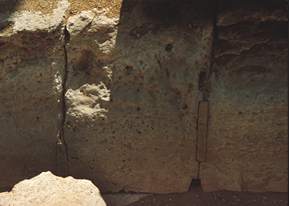 The
description above is of my own invention, but the fact that
something very like this has occurred in the distant past
is self-evident by the thousands and thousands of little repairs
that have been made all over the Vega pyramid, from the bottom
to the very top. The question is, though, who made them? The
records not only fail to mention the actual construction of
these pyramids, they also fail to mention the repairs that
were made to them. It has to be pointed out that the repairs
are not due to manufacturing errors, as the face of the pyramid
that was protected by the adjacent mortuary temple has no
repairs on its surface. Clearly the repairs were made to a
surface that had been eroded over many millennia, but when
was this done? The
description above is of my own invention, but the fact that
something very like this has occurred in the distant past
is self-evident by the thousands and thousands of little repairs
that have been made all over the Vega pyramid, from the bottom
to the very top. The question is, though, who made them? The
records not only fail to mention the actual construction of
these pyramids, they also fail to mention the repairs that
were made to them. It has to be pointed out that the repairs
are not due to manufacturing errors, as the face of the pyramid
that was protected by the adjacent mortuary temple has no
repairs on its surface. Clearly the repairs were made to a
surface that had been eroded over many millennia, but when
was this done?
Personally I think that if such a feat were
achieved in the relatively well documented New-Kingdom era
onwards (c 1500 BC), we would have heard about it. There are
records that document the repairs made to the Sphinx by Tuthmoses
IV during the New Kingdom era, yet the surface repairs to
the Dahshur pyramids was a far greater undertaking than this.
This tends to indicate that the repair-work was actually completed
in the ancient past - earlier than the New Kingdom. Remember
that the present condition of the pyramids is due to their
deliberate destruction in relatively recent history, had this
not taken place the major pyramids at Giza and Dahshur would
have been in good condition to this day. So if these pyramids
have lasted so well in the 3500 years since the New Kingdom
and not needed much in the way of repairs, as the evidence
from the Vega and Khafre pyramids indicates - why did these
pyramids need repairing so quickly after their supposed construction
by Snorferu in the 4th dynasty (c 2600 BC).
There is a deep conundrum here that is presented
by something as mundane as an inserted repair block, just
when was this major feat of repair work carried out? As the
Vega pyramid appears to have lasted for the last 3500 years
without any repairs, my solution is simple, if rather unorthodox
- the Vega (Bent) pyramid must be much greater than 3,500
years old. In fact the evidence from the current state of
the Vega pyramid points towards it requiring another surface
repair in the not too distant future, which would tend to
suggest that the surface can survive for just over double
this time-period. Thus if the repairs we see today were carried
out some 3,500 years ago, then the pyramid would have been
constructed some 7,000 years ago.
As has been speculated in many previous works,
including my own book "Thoth, Architect of the Universe",
this simple observation seems to indicate once more that these
high quality pyramids (those at Dahshur and Giza) were actually
built in the distant past. To refine this date further, though,
all we require is the date of the repair work. Can such a
date be found in the records?
Egyptology has attributed the Dahshur pyramids
of Vega and Draco to the pharaoh Snorferu and they indicate
that he built both of these plus the pyramid at Meidum, all
in the space of some 25 years. But not only does this seem
illogical and physically impossible, the pyramids themselves
have no inscriptions within them to confirm this proposal
- just a few cartouches on the outer casing and in the mortuary
temple. A much simpler solution, that will help considerably
with the dating process above, is that Snorferu is intimately
associated with these three pyramids not because he built
them all, but because he REPAIRED them all. If one is prepared
to accept this, then these pyramids have apparently lasted
some 4,600 years without further repairs to their fabric and
therefore the actual construction era for these particular
pyramids must have been many thousands of years BEFORE the
reign of Snorferu.
Such a scenario may be based on an amount of
guesswork, but it does make a great deal of sense and the
underlying evidence is irrefutable. Taken together with the
data from Meidum, Giza and at the Sphinx - does this not all
tend to reinforce the evidence that is emerging that these
pyramids are indeed much older than we have traditionally
been taught? The weight of evidence appears to be mounting
relentlessly, the pyramids would seem to be as much as double
or treble the orthodox age. Double the orthodox dating represents
9,000 years ago, and treble would indicate a massive 13,500
years, it is no wonder the orthodoxy would resist such an
interpretation of the facts.
Ralph Ellis

Visit
EDFU - Ralph's Website
| Copyright 1998, 1999 R. Ellis has
asserted his rights, in accordance with the Copyright,
Designs and Patents Act 1988 to be identified as the author
of this work. |

|