|
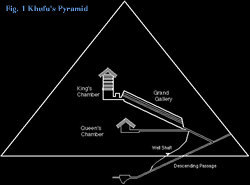
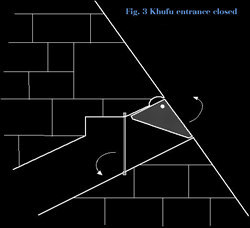
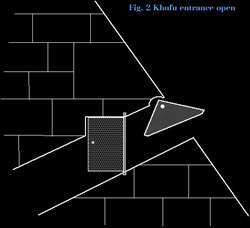
The diagrams above were developed by Petrie and
based on his analysis of the Vega (Bent) pyramid entrance.
The hinged stone door is clearly marked as the large shaded
stone. It needs to be this shape, with a long top extending
backwards, in order to counterbalance the weight of the
stone. The amount of counterbalance at the top would have
been judiciously arranged by the architect, so that the
force required to open the stone was within normal human
limitations, say about 25kg of force.
Invisible
Here then, we have clear evidence that a movable entrance
stone was fitted to the Khufu pyramid, and that the descending
passage had been visited, perhaps many times, throughout
recorded history. To gain entry to the pyramid, however,
was still not easy. A series of ladders would have to
be erected against the pyramid to reach the door. Presumably
the entry stone must have had a handle of some sort on
which to pull, and it would then need a prop of some nature
to keep it open, while the new initiate scrambled into
the thin hole and down the descending passage. A knotted
rope would also have to be fed slowly down the length
of the passage, to allow for an easy exit from the dark
and foreboding depths of the sacred pyramid.
Undoubtedly, all of this frenetic activity would have
scratched and pitted the entrance to the pyramid over
the millennia in a very obvious fashion. Yet, it is generally
accepted that the casing blocks must have been intact
during the rule of Ma'mun, as the casing blocks were used
by Sultan Hasan for the construction of his mosque in
1356. The question is, therefore, why could Ma'mun not
see these tell-tale marks and the original entrance to
the pyramid that lay only a few meters above him? Why
could he not see the handle on the door, or the scuff-marks
on the smooth exterior? The knowledge of the true entrance
must still have been known, so why could none of the locals
be 'persuaded' to point it out? This apparent invisibility
of the original entrance could not have been because it
was covered by sand, for instance, because Ma'mun's tunnel
lies below the level of the real entrance. So what was
the problem? Why so was much effort expended in digging
a new tunnel, when an easy entrance lay just above?
Two very important questions have just been posed Ð why
could Ma'mun not see the real entrance, when it was so
well known? And why was his alternative tunnel so accurate,
if he did not know where the real entrance was? Bit of
a catch-22 really.
Guide passage
Mark Foster had had an idea that Ma'mun already knew of
the original entrance and the descending passage, and
had used the new forced entry tunnel for another reason,
perhaps to get around the granite plug-blocks in the ascending
passage, perhaps to get the necessary equipment into the
right position to dig around those blocks. But if Ma'mun
did not discover the ascending passage while he was creating
his new forced tunnel, how did he know it was there? The
ascending passage was, after all, completely secret and
unexplored at this time, how was it discovered?
Mark and Ralph both came to the same conclusions on this
topic. The key to discovering the ascending passage lies
outside the pyramid, just to the east of the base and
to the north of the causeway. Here, there lies what Petrie
called the 'trial passage', which is simply a foreshortened
replica of the Khufu pyramid's descending passage and
the junction with the ascending passage.
As everything on the plateau has a purpose, why is it
there? Petrie thought it was a test-bed on which the architect
could test out the procedures for laying out the internal
passageways. This is a possibility. However, we both think
that the real answer is that it is not a 'trial passage',
but a 'guide passage'. Any interested party looking into
this short passage system will clearly see the symmetry
with the real descending passage inside the pyramid, but
a little further down they will come across a junction
with another ascending passage. The idea might just dawn
on someone that the real pyramid passageways just might
have the same configuration. Thus the ascending passage
was quite possibly found by Ma'mun's men entering the
original entrance to the pyramid and tapping down the
ceiling of the descending passage, searching for that
elusive passageway that was hinted at by the 'guide passageways'
outside. Success at last, the men found a concealed entrance!
But as they were not able to penetrate the granite plugs
that blocked this ascending shaft, a small tunnel was
dug through the softer limestone core-blocks, around the
granite plugs, and up into the ascending passage. Ma'mun
was at last able to enter the Queen's and King's chambers
and to plunder his expected booty.
If all this is so, however, it may also be an indication
of another passageway inside the Khufu pyramid. The only
difference between the 'guide passageways' and the real
passageways, is that the guide system has a vertical shaft
attached to the junction of the descending and ascending
passages. Mark believes this to be a sure sign that a
similar vertical shaft lies undiscovered within the Khufu
pyramid.
Excavation
This is all very well as scenario's go, you might say,
but if this is the case then why on Earth is that great
forced tunnel there? Surely the classical explanation
is correct, Ma'mun came in via this crude excavation!
- Perhaps, but here is where Ralph's traditional lateral
thinking comes into play. Tunnels are not only for getting
in, but also for getting out......
It is highly probable that the real reason for the forced
tunnel was not to get into the pyramid, but rather to
get 'something' OUT. Whatever it was, though, it must
have been small enough to go down the first part of the
ascending passage, but it was too long to go around the
bend between the descending and ascending passageways.
The only alternative for the intrepid explorers, was to
dig a tunnel directly outwards from the junction of the
two passageways, bypassing the constriction.
This explains both of the questions posed above. The original
entrance had been known about, and the accuracy of the
forced tunnel is because is was started from inside and
dug outwards. This may also explain why so much rubble
was later found in the bottom of the descending passage,
it came from the forced tunnel's excavations.
So what was the long thin booty that Ma'mun had found
and 'liberated'? Had the King's chamber been filled with
sacred and valuable artifacts and the mummy of a great
and ancient king? Had Ma'mun discovered a king's ransom
in bullion? Perhaps, but personally Ralph thinks that
the real answer is probably more prosaic and poignant
that this.
The Caliph's tale
Ma'mun laboriously climbed his way up the 41.2 cubits
of swaying ladders, to the original entrance of the Khufu
pyramid, a difficult task for a well-fed Caliph and a
worrying moment for his advisors. After a short slide
down the descending passage, he entered the small rough
shaft that his men had dug around the granite plug blocks
and scrambled into the ascending passage. From there he
struggled up the Grand Gallery, his men cautiously pushing
his bulk from behind. Sweating and cursing, he finally
crawled on hands and knees into the King's chamber, a
degrading and exhausting experience that no Caliph had
endured either before or since.
Ma'mun was flustered, even angry, but also elated. Although
he had been briefed that the King's chamber was basically
empty, what it did possess was an untouched, enigmatic
and completely sealed sarcophagus! This was the prize
that justified these privations, Ma'mun was going to be
at the opening of this sarcophagus at whatever cost Ð
he was not about to let his chief vizier run of with the
treasure of the ancient kings, or perhaps even the secrets
of the gods themselves!
A disorganised rabble of workmen arrived and prised at
the coffer lid with crow-bars; they cursed, swore and
shouted, but the lid just would not budge. Finally, in
a state of ecstatic anticipation, Ma'mun pushed the rabble
aside and ordered the coffer to be smashed with sledge-hammers.
The chief gaffir aimed a few heavy blows and with a great
crash, one corner of the sarcophagus flew off.
Ma'mun ordered the workers away, yelled for silence, grabbed
a flickering lamp from a soldier and approached the hole
in trepidation. Then, the significance of the moment struck
him. He was standing inside the greatest of all the world's
ancient monuments, a structure rumoured to have been constructed
by the gods themselves. Here at the heart of this sacred
monument lay a simple, unadorned, solitary black-granite
coffer, that had been sealed for thousands of years; and
he, Caliph al Ma'mun, was going to be the first to see
inside. His hand began to tremble at the thought and he
quickly steadied it with his other, least the workers
see him as apprehensive.
The light flickered and it was difficult to see, but at
last it steadied and he saw for himself that the sarcophagus
was ....... empty!
This is exactly what happened to the archeologist Zakaria
Goneim a millennium later. He was excavating the pyramid
of Sekhemkhet at Saqqara, when a sealed sarcophagus was
found complete with its 'funerary wreaths' still on the
top. With great difficulty the sliding end of the coffer
was raised and it was ...... empty!
Whilst Zakaria Goneim was greatly disappointed, the Caliph
Al Ma'mun was absolutely livid. Suspecting, perhaps, that
one of his workers had manufactured this little rouse,
he flew into a violent rage and vented his anger on a
few unfortunate victims of summary justice. Ma'mun was
not about to go back to his palace empty handed, after
all he had been through. But the chamber only contained
the sarcophagus and it was quite obvious that it was bigger
than the entrance to the chamber. As a consolation prize,
they found that the lid of the sarcophagus could be turned
diagonally and just about squeeze through the King's chamber's
tough granite entrance blocks. Ma'mun was going to have
it as a memento at all costs.
Unfortunately for the workers, however, after sliding
the great block of stone down the Grand Gallery, they
found that the lid was not going to squeeze around the
plug blocks and into the descending passage. Besides,
the lid must have weighed a tonne, and if it ever got
into the descending passage, nobody could think of a way
of preventing it from plunging all the way down to the
bottom of the pyramid. In addition, the original entrance
stone-flap was far too small to get the lid through. It
was all becoming a bit of a nightmare. Spurred on by an
enraged Caliph, however, the chief of engineering came
up with an answer. The only practical solution was to
force a new tunnel from the junction of the descending
and ascending passageways, horizontally through the core
blocks of the pyramid and into the open air. THIS is Ma'mun's
forced tunnel.
by
Ralph Ellis & Mark Foster.
P.S.
Many people continue to be critical of the 'strange' notion
that the Khufu pyramid chambers were designed and constructed
to be perfectly empty, it seems to be counter intuitive.
But all the evidence seems to point towards the Khufu
tomb being empty - just like the tomb of Sekhemkhet was
found to be in recent excavations. But this is not actually
so strange as it may first seem. The truth of the matter
is that a billion or so people today, known as Christians,
base their entire philosophy on just this concept - the
empty tomb. The Egyptologists will not rock the contemporary
boat with such symmetric symbolism, but perhaps the importance
of the history of Egypt is slowly becoming apparent to
some...

For further reading please see:
"Jesus, Last of the Pharaohs" by Ralph Ellis
"Thoth Architect of the Universe" by Ralph Ellis
Also, visit The
Ralph Ellis Website - Edfu

Copyright 1998, 1999
|