Click on any picture to view larger version.
| The so-called Wall of the Crow stands at the Southeast
corner of the Giza plateau beyond the Sphinx and her Temples.
Off the beaten track and rarely seen by most visitors to
the Plateau, it is yet one more mystery buried in the sands
at Giza... |
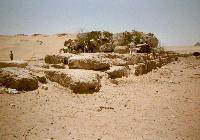
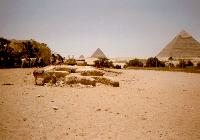
 View of the Wall
of the Crow looking towards the Second Pyramid. Said to
be a wall it has more in common with the giant causeways
that run from the three main pyramids at Giza down to
the Nile valley, the most well preserved of which is that
of Khafre's Pyramid although the remains of Menkaure's
causeway up near the Third Pyramid itself are still impressive.
Another reason for thinking it may be a causeway is it's
position. The eastern end of the structure is heading
out towards where the Nile would have been in Ancient
Egypt in a similar way to the causeways of the pyramids
at Giza. We know that the causeway of Khafre's pyramid
for example led to the Valley Temple where access to the
Nile was possible.The fact that the Wall of the Crow seems
to mirror this function adds to the argument that it is
a causeway and not a boundary wall.
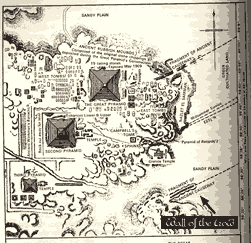 Take
a look at the following diagram of the Giza Plateau. Based
on an original map by Davidson & Aldersmith it clearly
shows the Wall of the Crow and marked alongside it is
the legend "Fragment of Ancient Causeway". Simon
Cox has brought to my attention the fact that Howard Vyse
also believed this structure to be a causeway (see
Simon's article A Sanctuary to Sokar). Take
a look at the following diagram of the Giza Plateau. Based
on an original map by Davidson & Aldersmith it clearly
shows the Wall of the Crow and marked alongside it is
the legend "Fragment of Ancient Causeway". Simon
Cox has brought to my attention the fact that Howard Vyse
also believed this structure to be a causeway (see
Simon's article A Sanctuary to Sokar).
Interestingly, you will notice the tunnel cutting through
the Wall. This is a feature found on at least two other
causeways at Giza, Khufu's causeway and Khafre's causeway
(not enough remains of Menkaure's causeway to say for
sure one way or the other whether or not such a feature
existed here too). On the Wall of the Crow however, we
seem to have a purpose made feature whereas on the other
causeways we find rough hewn tunnels
(view picture of tunnel cutting through Khufu's causeway
in Gallery). |
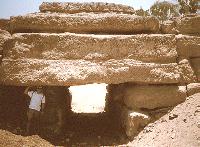
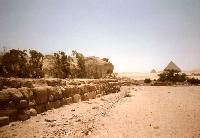
Here we catch a glimpse of the scale of some of the blocks
that make up the Wall of the Crow. Some of these individual
blocks have a lot in common with the cyclopean masonry
found in the Second and Third Pyramid's Valley Temples.
Although impressive enough today, what we are looking
at here is only the top of this structure, and much like
an iceberg, two-thirds of the Wall of the Crow are hidden
from view! Sand still buries most of the structure and
it is estimated to be somewhere in the region of 45 feet
tall. If we were to clear away all of the sand we would
be faced with an awesome sight and it would simply tower
above us. What you see of the feature on the right for
example is only the top of this entrance. The walls slope
outwards as they near the ground, revealing an impressive
gateway. |
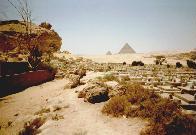
 Now
if we take into account all that we have discussed so far
and assume for a moment that it is a causeway and not a
boundary wall then we are left with one problem, a causeway
that seemingly does not lead anywhere at all...not anymore
at least. Now
if we take into account all that we have discussed so far
and assume for a moment that it is a causeway and not a
boundary wall then we are left with one problem, a causeway
that seemingly does not lead anywhere at all...not anymore
at least. |
 However,
if we follow the causeway West it leads us right into the
heart of the modern Muslim cemetery. Surely if there is
one site on the Giza plateau that has not been the subject
of extensive excavation this is it... Could there be the
remains of something underneath
the modern Muslim tombs? Something to which the causeway
originally led? Why exactly is this cemetery on this spot?
Did the original builders of that cemetery know something
we do not know? However,
if we follow the causeway West it leads us right into the
heart of the modern Muslim cemetery. Surely if there is
one site on the Giza plateau that has not been the subject
of extensive excavation this is it... Could there be the
remains of something underneath
the modern Muslim tombs? Something to which the causeway
originally led? Why exactly is this cemetery on this spot?
Did the original builders of that cemetery know something
we do not know? |
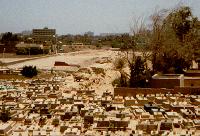
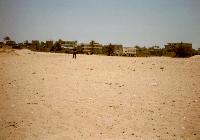
Here we have the view looking towards the Wall of the
Crow showing it ending right in the middle of the cemetery.
Whilst it is entirely possible that there might have
once been a structure at this Western (the cemetery) end
of the Wall, there should too be have been a structure
at the Eastern End too. Indeed, the other causeways at
Giza have structures at both ends - Pyramids at one end
and temples at the other.
Understandably, it is very unlikely there will ever be
an excavation on the site of the cemetery while the tombs
remain, so maybe we should look to the Eastern end. In
fact I feel it is at the Eastern end that we should expect
to find something of much greater significance.
If we follow the causeway Eastwards it ends abruptly
in the sand... |
| Let's examine why I think we should focus
on this Eastern End.
If we take a look at recent ideas being developed by
Alfonso Rubino (see diagram below) and others we will
see that Giza seems to have been designed with very strict
geometrical rules laid down from the start. We can see
from this work that there was a unified ground plan for
the site that was clearly in the designers mind right
from the start. For example the angle of slope of the
main triangle in the diagram below matches exactly the
angle of the Second Pyramid. Furthermore the angles of
both the Great Pyramid and the Third Pyramid are also
obtainable from the diagram. Along with these, we can
get the Third Pyramid's height along with all the other
Pyramid's dimensions from this geometrical representation
of Giza. The Sphinx's position also fits very neatly into
the geometry as does the angle of Khafre's causeway and
other important features on the plateau...This cannot
be coincidence. The layout of all three Pyramids along
with the Sphinx had to have been designed from the start
as a whole unit... |
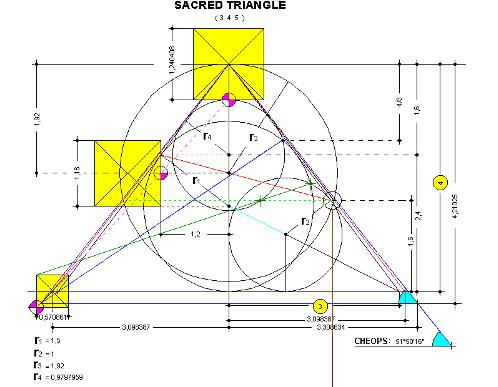
Alfonso Rubino's Geometrical Analysis of Giza
| Amazingly, the architect managed to also
incorporate a sacred 3:4:5 triangle into the site layout,
surely not a consideration of three separate pharaohs
each building their own tomb? Why would these three kings
have cared whether their monuments related to each other
in this way? To my mind there is obviously a lot more
to Giza than just three King's tombs unless there is something
fundamental we are not grasping concerning Ancient Egyptian
Funerary beliefs?
You will notice from the above that there is one corner
of the sacred 3:4:5 triangle that is not represented on
the ground at Giza by any monument, the bottom right-hand
corner. Now if we add to this sacred triangle the Wall
of the Crow the following can be noted... |
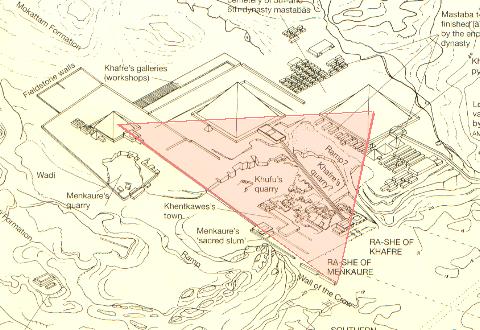
| The eastern end of the Wall of the Crow intersects
with the base-line of the sacred triangle (which runs along
Menkaure's causeway) at precisely
the point where the triangle's corner should
be on the ground... Menkaure's causeway runs exactly East
while the Wall of the Crow is offset at approximately 7
degrees. Where the two meet up marks the corner of our 3:4:5
triangle. From this it would appear as if this is the
point to which the Wall of the Crow leads us. It is all
the more strange therefore, that it should lead us to
nothing but sand.
Was there at one time a temple or other structure situated
at this point on the Plateau or does the geometry point
to an underground structure?
We know from other monuments, such as the Great Pyramid
itself, that the builders of these structures incorporated
underground chambers and passages, built with amazing
skill into their above-ground constructions. Is there
something waiting below our feet at the end of the Wall
of the Crow, something to which three lines on the Giza
plateau seem to be pointing to directly?
Something which has been forgotten for millennia? |
| This page and all photographs
are copyright of Mark James Foster except where stated. They
can only be used with the consent of the author. The geometrical
representation of Giza is copyright Alfonso Rubino. |

|